
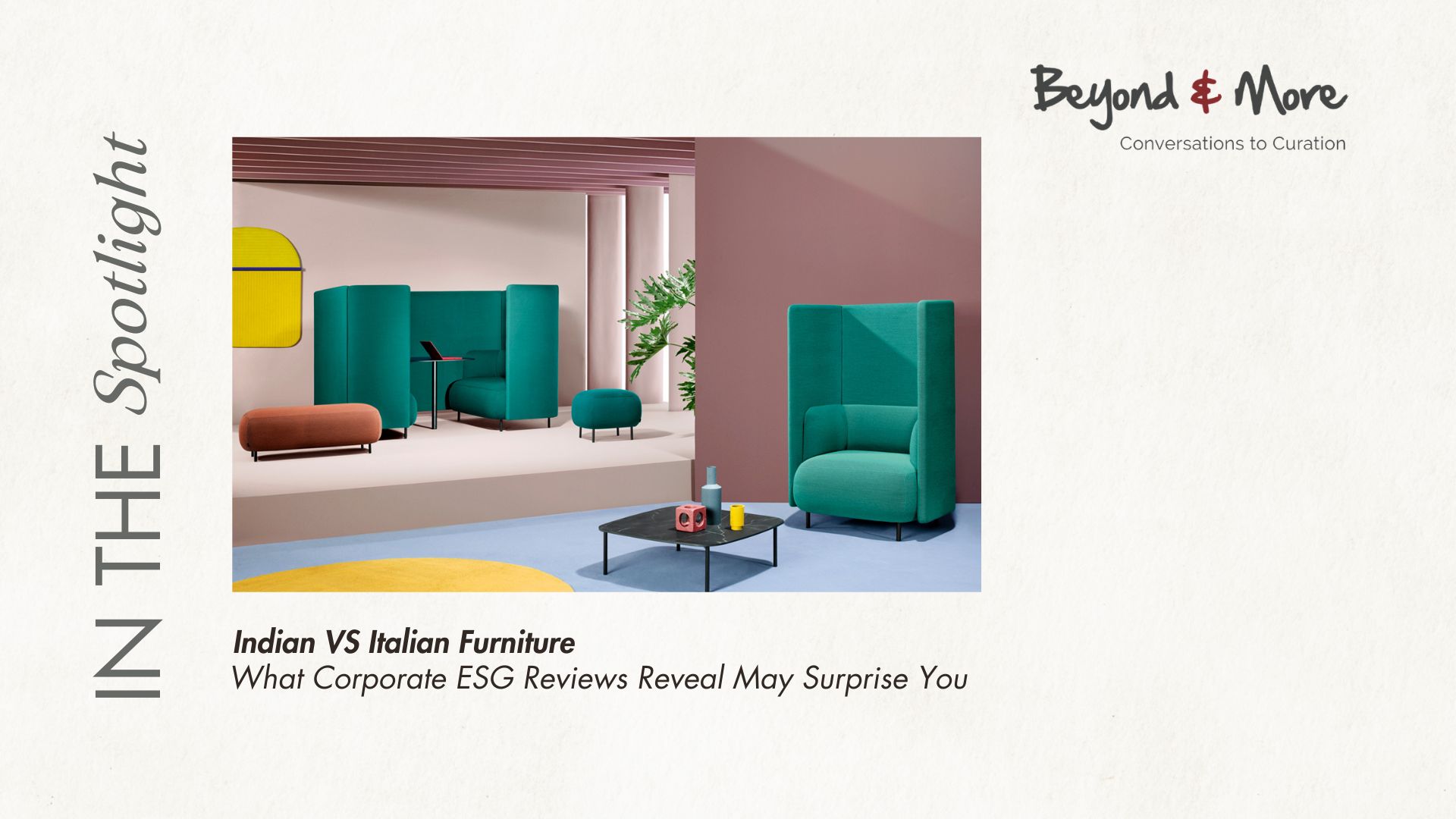
ESG & Sustainability Comparison Report
Corporate Client Sustainability, Ethics & Value Rationale
Purpose of This Report
This report is designed for corporate clients and institutional stakeholders to explain the sustainability, ethical, and governance rationale behind sourcing furniture from Italy versus local manufacturing alternatives.
The objective is to support procurement, ESG, finance, and leadership teams in making decisions that align with:
• Corporate ESG and BRSR commitments
• Brand and reputational risk management
• Long-term asset value and operational efficiency
The assessment adopts a life-cycle and risk-based perspective, moving beyond upfront cost and distance to focus on durability, accountability, and total ESG
impact.
1. How the Assessment Was Done
The comparison is based on a simplified life-cycle approach that considers:
• Where the wood comes from
• How much energy is used during manufacturing
• Transport (local and international)
• How long the furniture lasts, based on warranty
Importantly, carbon emissions are assessed not only per product, but also per year of use, which gives a clearer picture of long-term environmental impact.
2. Environmental Impact (E)
2.1 Wood & Raw Materials
• India-made furniture uses non-certified wood. This increases the risk of unsustainable forestry, deforestation, and biodiversity loss. Emissions from poor forestry practices can be very high.
• Italy-made furniture uses FSC-certified wood, which ensures forests are responsibly managed, replanted, and protected.
What this means: Certified wood from Italy significantly reduces environmental and biodiversity risks.
2.2 Manufacturing Energy
• India: Manufacturing mainly relies on grid electricity, which is still carbonintensive.
• Italy: Manufacturing is powered by renewable energy, resulting in near-zero emissions from production.
What this means: Clean energy use in Italy dramatically lowers the carbon footprint of manufacturing.
2.3 Transport Emissions
• India: Shorter transport distance (around 400 km by road).
• Italy: Longer journey involving trucks in Italy, sea freight to India, and trucking within India.
What this means: Imported furniture has higher transport emissions, but sea freight is relatively efficient. These emissions are offset by cleaner manufacturing and better material sourcing.
2.4 Durability & Product Life
• India: 1-year warranty suggests shorter lifespan and more frequent replacement.
• Italy: 5-year warranty indicates better build quality, durability, and repairability.
What this means: When emissions are spread over years of use, Italian furniture has a much lower carbon footprint per year and generates less waste.
3. Social Impact (S)
3.1 Labour Practices & Working Conditions
• India-made furniture: The local furniture ecosystem is diverse and costcompetitive, but often involves fragmented supply chains with varying levels of formalisation. This can limit visibility into standardised labour practices, workplace safety, and long-term employee welfare.
• Italy-made furniture: Italian manufacturers operate within a highly regulated European framework that mandates worker safety, fair wages, social security, and ethical employment standards.
Why this matters to clients: Strong labour standards reduce ethical, compliance, and reputational risks while ensuring that products are created under dignified and responsible working conditions.
3.2 Original Design & Design Integrity
• India-made furniture: A large portion of the market focuses on cost-efficient production inspired by global design trends. While commercially practical, this approach offers limited investment in original design development.
• Italy-made furniture: Italian furniture is globally recognised for original design thinking, long development cycles, craftsmanship, and respect for intellectual property.
Why this matters to clients: Choosing original design supports creativity, innovation, and authenticity — values increasingly important to premium projects, brand positioning, and long-term asset quality.
3.3 Responsible Consumption & Social Value
• Longer-lasting, well-designed furniture reduces frequent replacement and disposal.
• Lower replacement cycles mean fewer repetitive manufacturing and logistics activities, reducing physical strain and safety risk for workers across the value chain.
Social benefit: Durable, original products promote responsible consumption and more stable, higher-quality employment.
4. Governance & Transparency (G)
• Design governance: Original design ownership in Italian furniture demonstrates respect for intellectual property, transparent licensing, and ethical commercial practices.
• India-made furniture: Limited enforcement of design protection and weaker governance around copying increases legal, reputational, and ethical risk.
• Supply-chain transparency:
o India: Limited traceability of wood, energy sources, and labour conditions.
o Italy: Clear traceability through FSC certification, renewable energy sourcing, audited supply chains, and export-grade compliance.
• Warranty & accountability:
o India: 1-year warranty reflects lower manufacturer accountability beyond sale.
o Italy: 5-year warranty demonstrates long-term responsibility for product performance and customer trust.
Governance benefit: Stronger oversight of design rights, labour standards, materials, and warranties reduces compliance and reputational risk.
5. Carbon Footprint Comparison
Total Carbon Emissions per Unit
• India-made furniture: ~29 kg CO₂
• Italy-made furniture: ~38 kg CO₂
Although the imported option has higher upfront emissions, this does not tell the full story.
Carbon Emissions per Year of Use
• India (1-year life): ~29 kg CO₂ per year
• Italy (5-year life): ~7.6 kg CO₂ per year
Key insight: Italian furniture is far more carbon-efficient over its usable life.
6. Corporate ESG Conclusion
From a corporate procurement and governance perspective, furniture sourced from Italy demonstrates stronger alignment with enterprise ESG objectives and long term value creation.
Key corporate-relevant advantages include:
• Reduced life-cycle carbon intensity when assessed on a per-year-of-use basis
• Lower replacement and waste-management costs due to superior durability
• Reduced ESG, compliance, and reputational risk through certified sourcing and transparent supply chains
• Strong labour governance aligned with international standards
• Design authenticity that supports corporate brand positioning and avoids intellectual property risk
• Clear accountability through extended warranties and post-sale responsibility
These attributes collectively support sustainable procurement, audit readiness, and stakeholder confidence.
7. Corporate Procurement Recommendation
For corporate clients seeking to align sourcing decisions with ESG targets, BRSR reporting, and long-term operational efficiency, furniture procurement should prioritise life-cycle value and governance quality over short-term cost considerations.
Suppliers that demonstrate:
• Certified and traceable raw materials
• Low-carbon and renewable-energy manufacturing
• Ethical and regulated labour practices
• Original design ownership and quality assurance
• Extended warranties and documented accountability
provide measurable benefits in terms of ESG performance, risk mitigation, and asset longevity.
Accordingly, furniture sourced from such manufacturers — including qualified international suppliers — represents a strategic, responsible, and future-aligned choice for corporate environments.
Quantitative Evidence – Consolidated Carbon Footprint
Assumptions:
Option A — Made in India
• Wood: Non-FSC
• Transport: 400 km by truck (India)
• Manufacturing energy: assumed grid-dominant (typical India)
• Warranty: 1 year
Option B — Made in Italy (Imported)
• Wood: FSC
• Transport:
o Italy inland: 500 km (truck)
o Italy → India: sea freight
o India inland: 500 km (truck)
• Manufacturing energy: assumed cleaner European grid / partial renewables
• Warranty: 5 years
Consolidated Carbon Footprint Comparison (kg CO₂ per unit)
Carbon Component India – Local Manufacturing Italy – Imported Manufacturing
Manufacturing energy 18.0 0.0
Transport (product only) 4.0 18.0
Packaging material 5.0 18.0
Extra transport due to packaging 0.2 2.0
Carbon Component India – Local Manufacturing Italy – Imported Manufacturing
Logistics inefficiency / damage risk 2.0 0.0
Total embodied CO₂ (excl.wood risk) 29 kg 38 kg
Governance Interpretation:
While the imported option carries higher upfront emissions, the organisation considers full life-cycle accountability, logistics reliability, and durability rather than distance alone. The Italian supplier demonstrates higher transparency and control over emissions sources through renewable energy usage, certified materials, export-grade logistics, and extended warranties.
Lifecycle Accountability & Risk Management
Governance Indicator India Italy
Wood traceability Limited FSC-certified
Manufacturing energy transparency Limited Renewable, auditable
Packaging governance Basic Engineered, export-grade
Warranty commitment 1 year 5 years
These factors reduce governance, compliance, and reputational risk and align with Principle 1 expectations.
BRSR Principle 3
Businesses should respect and promote the well-being of all employees, including those in their value chains
Social & Value-Chain Context
Worker well-being extends beyond direct manufacturing to logistics, packaging, and handling activities. Packaging quality, transport efficiency, and logistics governance materially affect worker safety, workload, and exposure to risk.
Quantitative Evidence – Annualised Carbon Impact
Metric India Italy
Total embodied CO₂ per unit ~29 kg ~38 kg
Warranty / expected service life 1 year 5 years
CO₂ per year of use ~29 kg/year ~7.6 kg/year
Social Interpretation:
Lower annualised carbon impact reflects reduced replacement frequency, lower production cycles, and less repetitive handling and transport. This reduces worker exposure to physical risk and supports sustainable employment practices across the value chain.